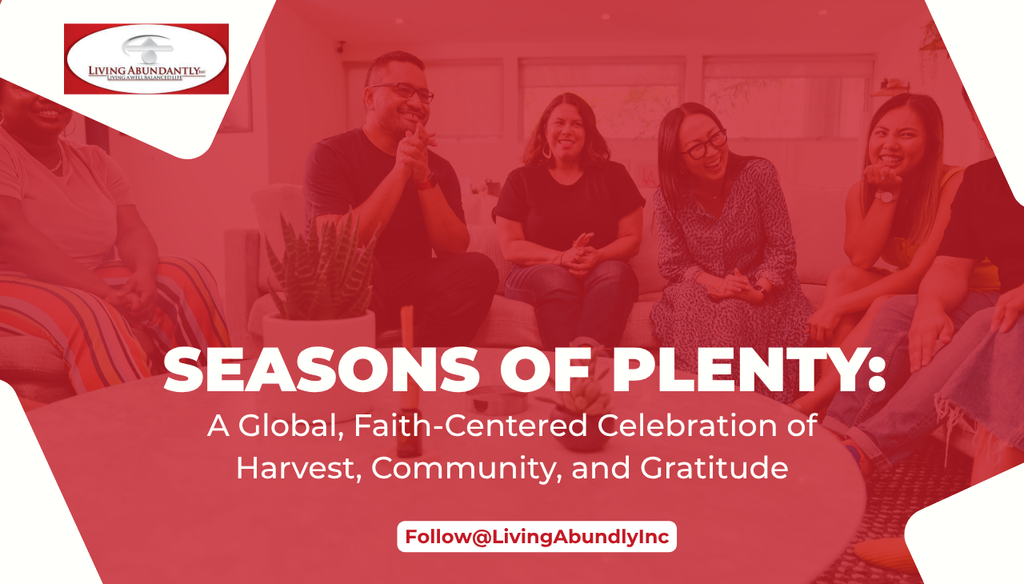
Harvest does not look the same everywhere.
In some regions, October brings autumn fields and cooler weather. In other parts of the world, people are planting rather than gathering. Some communities experience tropical growing cycles, rainy and dry seasons, or agricultural rhythms that do not match the traditional four-season calendar at all.
Yet across geography and culture, people understand the meaning of provision.
Food grown. Work completed. Families sustained. Tables shared. Neighbors supported. Needs met.
A faith-centered harvest celebration gives us language for something even deeper: gratitude to God for provision, humility about our dependence on one another, responsibility for what has been entrusted to us, and a renewed commitment to ensure that abundance becomes service rather than self-focus.
Living Abundantly Vision’s approach to abundant living consistently connects faith with purpose, family, holistic development, community support, and service.
A Faith-Centered Harvest Celebration Begins with the Giver
Harvest imagery can easily become focused on what has been gathered.
Scripture redirects attention toward the One from whom provision ultimately comes.
Faith teaches us that gratitude should not depend entirely on quantity.
A plentiful season can produce gratitude. So can a season in which God provided exactly enough.
A strong year can produce gratitude. So can a difficult year in which faith, family, and community carried us.
This keeps abundance from becoming purely material.
| “The deepest harvest is not simply what fills the table. It is the faith that remembers who provided, who labored, and who still needs a place at it.” |
First Thessalonians call believers to cultivate thanksgiving in every circumstance.
That mindset changes the posture of celebration.
Instead of entitlement, we choose stewardship. Instead of assuming provision, we recognize it. Instead of asking only how much we have, we ask what God wants us to do with it.
Community Is Part of the Harvest
No table is truly built by one person.
Farmers grow. Workers transport. Markets distribute. Families prepare. People serve. Communities share.
Even outside agriculture, the pattern remains.
Our lives are interconnected.
A career opportunity may have begun with someone’s recommendation. A child’s growth may reflect teachers, parents, mentors, and extended family. A community program may exist because volunteers gave time. A ministry may continue because people prayed, served, contributed, organized, taught, and led.
The early Christian community described in Acts practiced shared life, fellowship, generosity, meals, worship, and attention to the needs around them.
That model challenges the idea that abundance is merely private.
What happens when our tables grow larger? When families look beyond themselves? When faith communities know the needs around them? When professionals mentor younger leaders? When those with resources support people carrying heavier burdens?
| “A season of plenty becomes a season of purpose when the harvest creates room for someone else.” |
Harvest does not look the same everywhere.
In some regions, October brings autumn fields and cooler weather. In other parts of the world, people are planting rather than gathering. Some communities experience tropical growing cycles, rainy and dry seasons, or agricultural rhythms that do not match the traditional four-season calendar at all.
Yet across geography and culture, people understand the meaning of provision.
Food grown. Work completed. Families sustained. Tables shared. Neighbors supported. Needs met.
A faith-centered harvest celebration gives us language for something even deeper: gratitude to God for provision, humility about our dependence on one another, responsibility for what has been entrusted to us, and a renewed commitment to ensure that abundance becomes service rather than self-focus.
Living Abundantly Vision’s approach to abundant living consistently connects faith with purpose, family, holistic development, community support, and service.
A Faith-Centered Harvest Celebration Begins with the Giver
Harvest imagery can easily become focused on what has been gathered.
Scripture redirects attention toward the One from whom provision ultimately comes.
Faith teaches us that gratitude should not depend entirely on quantity.
A plentiful season can produce gratitude. So can a season in which God provided exactly enough.
A strong year can produce gratitude. So can a difficult year in which faith, family, and community carried us.
This keeps abundance from becoming purely material.
| “The deepest harvest is not simply what fills the table. It is the faith that remembers who provided, who labored, and who still needs a place at it.” |
First Thessalonians call believers to cultivate thanksgiving in every circumstance.
That mindset changes the posture of celebration.
Instead of entitlement, we choose stewardship. Instead of assuming provision, we recognize it. Instead of asking only how much we have, we ask what God wants us to do with it.
Community Is Part of the Harvest
No table is truly built by one person.
Farmers grow. Workers transport. Markets distribute. Families prepare. People serve. Communities share.
Even outside agriculture, the pattern remains.
Our lives are interconnected.
A career opportunity may have begun with someone’s recommendation. A child’s growth may reflect teachers, parents, mentors, and extended family. A community program may exist because volunteers gave time. A ministry may continue because people prayed, served, contributed, organized, taught, and led.
The early Christian community described in Acts practiced shared life, fellowship, generosity, meals, worship, and attention to the needs around them.
That model challenges the idea that abundance is merely private.
What happens when our tables grow larger? When families look beyond themselves? When faith communities know the needs around them? When professionals mentor younger leaders? When those with resources support people carrying heavier burdens?
| “A season of plenty becomes a season of purpose when the harvest creates room for someone else.” |
October Connects Local Faith with Global Need
October also carries a timely global reminder.
World Food Day is observed on October 16. In 2026, the Food and Agriculture Organization of the United Nations is emphasizing the theme “Innovate today. Nourish tomorrow.” FAO notes that hundreds of World Food Day activities take place across as many as 150 countries and calls for collective action across communities and sectors.
For faith communities, these global realities should not remain abstract.
Gratitude for food should deepen compassion for people facing hunger.
Thankfulness for stability should make us more attentive to families navigating insecurity.
Celebration should expand our awareness rather than narrow it.
FAO emphasizes that meaningful change requires cooperation among governments, businesses, producers, civil society, academia, young people, and individuals.
Faith communities belong within that landscape of action.
They can organize food support. Serve community meals. Assist families. Mentor young people. Partner with local organizations. Support farmers or food programs. Teach stewardship. Reduce waste. Advocate compassionately. Pray—and then look for practical ways prayer can become service.
Gratitude Becomes Stronger When It Moves Beyond Words
It is possible to say “thank you” and remain unchanged.
Biblical gratitude should shape behavior.
If we are grateful for family, we should invest in family. If we are grateful for community, we should participate in community. If we are grateful for provision, we should steward provision. If we are grateful for wisdom, we should share wisdom. If we are grateful that someone mentored us, we should consider who needs guidance now.
Living Abundantly Vision’s From Surviving to Serving article describes legacy through consistent acts of love, leadership, mentorship, generosity, and community care. Read From Surviving to Serving
That is gratitude becoming a movement.
Families Can Make Harvest a Teaching Season
October gives families practical opportunities to teach faith and stewardship.
Children and young people can participate rather than merely observe.
Invite them to help prepare a meal for someone. Let them select items for a food drive. Discuss where food comes from and why waste matters. Ask who in the community may need support. Create a family gratitude list. Talk about the people whose work makes daily life possible. Pray for families facing hardship. Volunteer together.
Faith becomes memorable when it is practiced.
Living Abundantly Vision’s family-development approach highlights communication, faith, holistic support, and shared service as ways families grow stronger together. Read The Abundant Family
A child who grows up seeing generosity as normal receives a powerful lesson:
Abundance is not only having. It is sharing.
Our Differences Do Not Cancel Our Shared Responsibility
A global harvest celebration should respect difference.
Cultures do not need to celebrate in identical ways to share values of gratitude, hospitality, stewardship, and community.
One family may gather around rice. Another around bread. Another around cassava. Another around maize. Another around food produced in an entirely different climate.
The point is not sameness.
The point is recognizing common human dependence.
We depend on creation. On labor. On community. On systems. On relationships. And, from a faith-centered perspective, ultimately on God.
The CDC’s work on social connection reinforces that supportive relationships and community belonging can strengthen wellbeing and resilience, and that connected communities are more likely to foster mutual support and giving back.
Faith adds another layer to that responsibility:
Love your neighbor not only when the neighbor looks like you, lives like you, or worships beside you—but because service is part of faithful living.
Seven Ways to Celebrate a Season of Plenty with Purpose
1. Begin with gratitude to God. Name provision specifically—food, relationships, health, opportunities, wisdom, support, and grace.
2. Learn about the people behind your provision. Help your family recognize the labor, systems, and communities involved in everyday resources.
3. Share your table. Invite someone, prepare a meal, contribute food, or support a household experiencing need.
4. Serve as a family or faith community. Choose one practical October service project that addresses a real local need.
5. Reduce unnecessary waste. Treat stewardship as a spiritual practice.
6. Connect local gratitude with global awareness. Use World Food Day or another community moment to discuss food access, generosity, and shared responsibility.
7. Carry the harvest mentality forward. Do not let generosity end when October ends. Build service into the normal rhythm of life.
| REFLECTION BOX• What provision in my life have I begun to take for granted?• Who helped make this season of abundance possible?• Where is there need close enough for me to respond practically?• What can my family or community share without waiting for a major event?• How can gratitude become a lasting lifestyle instead of a seasonal practice? |
The Harvest Is an Invitation
As this October series closes, three truths come together.
Gratitude helps us recognize abundance.
Revival reconnects us to the Source of our purpose.
And harvest reminds us that what has grown should become useful.
Living Abundantly Vision believes abundance is expressed through faith, wholeness, service, leadership, strengthened families, and community impact—not simply personal accumulation.
The harvest is worth celebrating.
But celebration should widen our hearts.
Toward God. Toward family. Toward neighbors. Toward communities beyond our own. Toward those who are still waiting for provision.
This is how abundance becomes legacy.
| “A faithful harvest does more than fill our hands with gratitude; it opens our hands so abundance can keep moving.” |
TURN GRATITUDE INTO FAITHFUL ACTION
Explore resources designed to strengthen spiritual growth, personal purpose, family wellbeing, and whole-life abundant living.
Explore Living Abundantly Programs and Coaching
Explore Spiritual Life Coaching